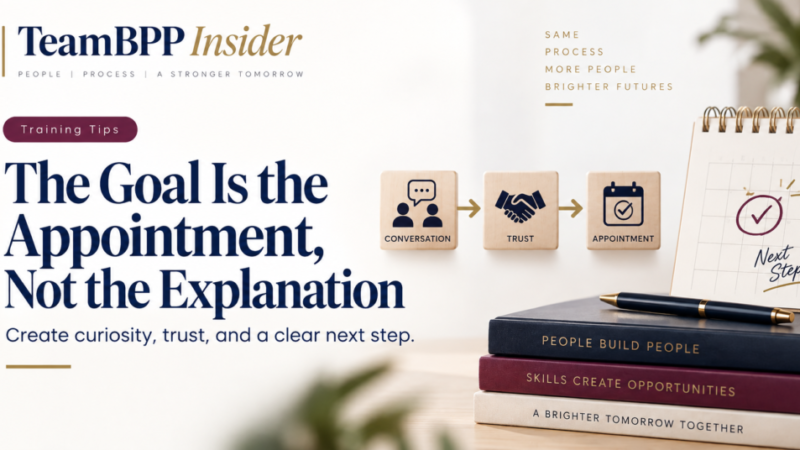
One of the easiest ways to make prospecting harder than it needs to be is to confuse a conversation with a presentation.
When someone asks what you do, it can feel natural to explain everything. You want them to understand the products, the business model, the financial concepts, the carriers, the compensation, and why you are excited. Before long, a simple conversation has turned into a twenty-minute seminar that nobody asked for.
The goal of the first conversation is usually much simpler: create enough clarity and curiosity to earn the next conversation.
You Do Not Have to Explain Everything
People do not need every detail before they agree to learn more. In fact, too much information too early can make a good opportunity feel complicated. The first conversation should help the other person understand why a meeting may be worth their time.
That means your job is not to prove how much you know. Your job is to listen, identify what matters to them, and connect what they said to a reason for meeting.
If someone says retirement feels uncertain, you do not need to immediately explain an IUL, annuity, participation rate, cap, floor, or tax strategy. You can simply acknowledge the concern and invite them to a conversation where their full picture can be reviewed.
If someone says they are frustrated with their income or career, you do not need to explain the entire compensation structure. You can learn what they want to change and invite them to see what the business actually looks like.
Curiosity Is More Powerful Than a Data Dump
A good invitation gives the person a reason to want the next step. It leaves room for questions instead of trying to answer questions they have not asked yet.
Think about the difference between these two approaches:
“Let me tell you everything we do.”
versus:
“Based on what you just told me, I think it would be worth sitting down for a proper conversation. We can look at what you are trying to accomplish and see whether anything we do actually fits.”
The second approach is calmer, more professional, and more client-centered. It does not pressure the person to understand a product before they understand their own need.
Ask Better Questions Before You Give Better Answers
Strong conversations are built around questions. You are trying to learn enough to understand whether a next step makes sense.
- What are you working toward financially right now?
- What feels most uncertain about retirement?
- If something happened to your income, what would that change for your household?
- What do you wish you understood better about your current plan?
- What would you change about your career or income if you had the option?
These questions create a real conversation. They also keep you from making assumptions.
The Appointment Gives the Conversation Structure
A scheduled meeting creates room to slow down and do the work properly. That is where you can use the Wealth Analysis, gather information, identify gaps, explain concepts, and decide what needs to happen next.
Trying to do all of that in a hallway, at a family gathering, in a text thread, or during a quick phone call usually creates confusion. The appointment protects the process.
Keep the First Step Small
People are more likely to move forward when the next step feels clear. Instead of asking them to make a financial decision, ask them to have a conversation. Instead of asking them to join a business, ask them to look at how the business works. Instead of asking them to understand everything, ask them to take the next logical step.
That is the discipline: do not turn every conversation into a presentation.
The goal is not to say everything. The goal is to say enough to earn the next conversation.